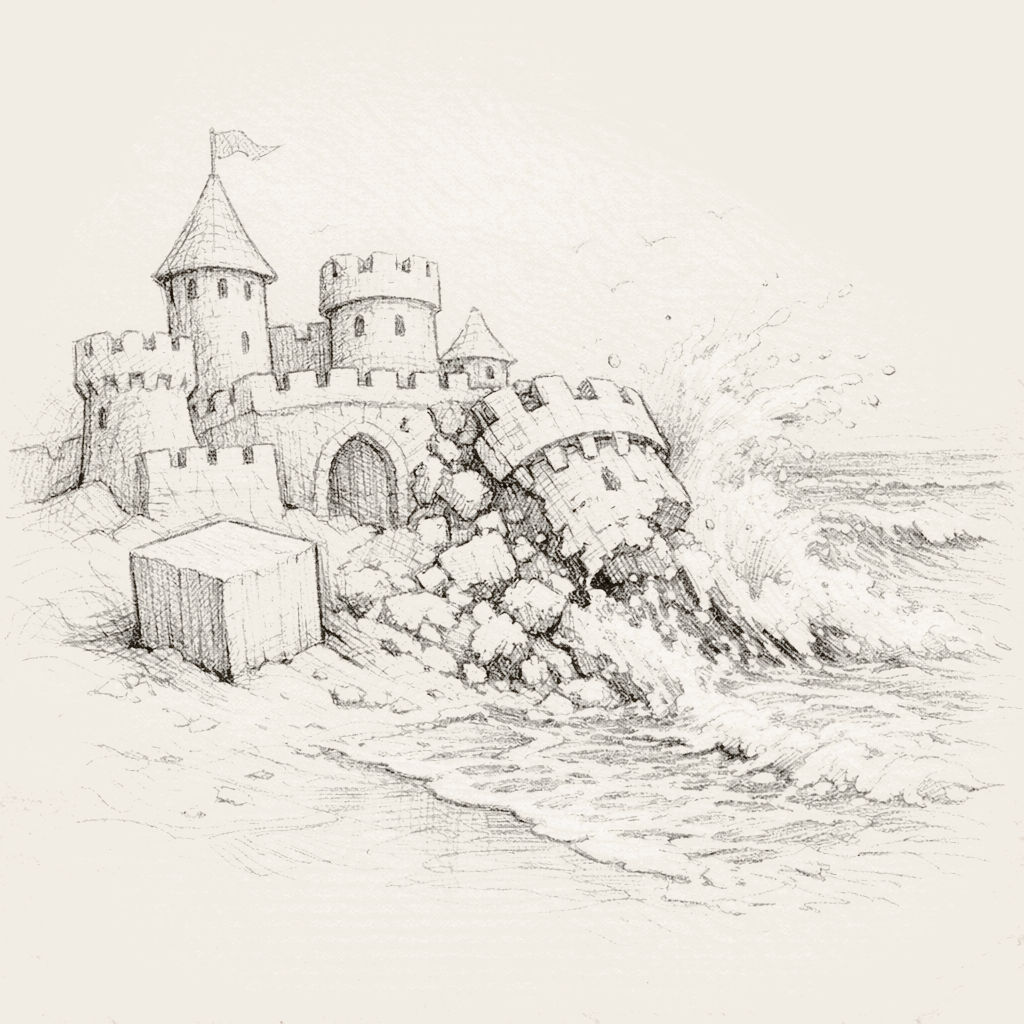
You built it. It looks impressive. It won't last.
Not because you worked too little. Not because you lacked intelligence or effort or vision. Because the foundation was wrong — and a sand castle, however tall, however carefully constructed, is only ever one tide away from gone.
The hard truth about misvaluation is that it is invisible while you're doing it. You cannot see sand by looking at the structure above it. You see the towers, the detail, the work. The sand only becomes visible when the tide comes in.
What you value determines what you build.
Every decision you make is a wager on what's real. Where you invest your time. What you trade your years for. What you teach your children to want. These are not neutral choices — they are expressions of a framework of value that you may have never explicitly examined.
Most of us inherited our value framework. We absorbed it from the culture, from what was rewarded around us, from what the people we admired seemed to pursue. It was handed to us, and we built on it. Some of what we inherited was solid. Some of it was sand. The problem is that sand and solid ground feel identical under your feet until the water arrives.
The shift is disorienting. It is also necessary.
Seeing the sand for what it is doesn't feel like liberation — not at first. It feels like loss. The thing you were building meant something to you. The years you spent building it were real years. The recognition that the foundation was wrong is not a small thing.
But a paradigm shift — a genuine revaluation of what's actually worth building on — is the beginning of something. Not the end. The person who keeps building on sand after they've seen it is not committed; they're trapped. The person who stops, examines the ground, and starts again somewhere more solid hasn't wasted their past. They've bought their future.
This site exists for that second kind of person.
Not for the person who needs to be convinced something is wrong. For the person who already suspects it — who has the low-grade awareness that something in the framework isn't holding, that the returns aren't matching the investment, that the structure is impressive but hollow. That person is ready to look at the ground.
We are interested in what misvaluation looks like in practice — where it shows up, how it hides, what it costs over time. And we are interested in what solid ground actually is: not the easy answer, not the slogan, but the examined and tested foundation that a life can actually be built on.
The tide is coming. It always does. What you're standing on now is what matters.